
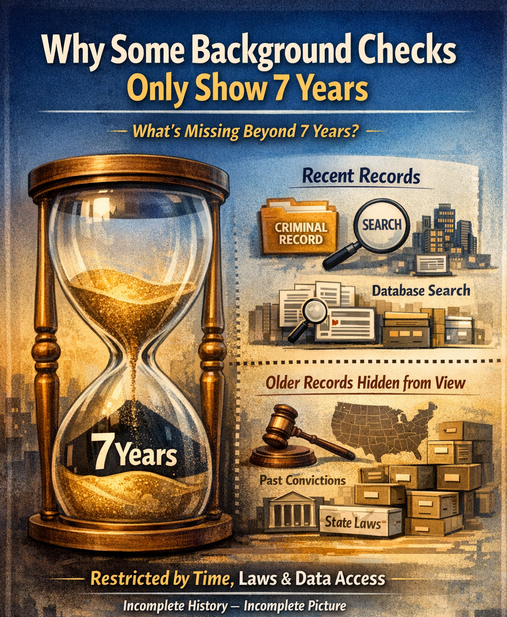
Understanding how background checks help HR professionals make informed and compliant hiring decisions.
Why Some Background Checks Only Show 7 Years
When HR professionals review a background check, one question comes up often.
Why does the report only show about 7 years of criminal history?
After working in background screening for almost two decades, the answer is usually a combination of law, data access, and how the search is conducted.
Below are the most common reasons.
1. The Fair Credit Reporting Act Influences Reporting
The Fair Credit Reporting Act (FCRA) sets rules for background checks used for employment.
One part of the law limits how long certain non-conviction information can be reported.
Examples include:
- Arrests that did not lead to conviction
- Civil judgments
- Paid tax liens
- Collection accounts
These items generally cannot be reported after 7 years for most jobs unless the applicant will be making over $75,000 annually.
Important point:
Criminal convictions are not limited to 7 years under the FCRA. Many employers do not realize this distinction.
2. Some States Set Their Own Reporting Limits
Several states have laws that restrict how far back certain criminal information can be reported. Restricted States Include: California, Colorado, Kansas, Maryland, Massachusetts, Montana, New Hampshire, New Mexico, New York, Texas & Washington. Some of these states include salary caps for restricting.
When either the employer or the candidate currently resides in one of these states, those rules may apply.
Massachusetts
- Arrests, Indictments, Convictions from date of disposition, release or parole are not reportable after 7 years.
New York
- New York restricts convictions to 7 years from date of disposition, release or parole unless the candidate will be making over $25,000 annually.
Because laws vary by state, many screening companies apply a blanket 7-year policy nationwide to simplify compliance. While safe, that approach can also mean older records are never searched or reported.
3. Database Searches Often Only Contain Recent Records
Many screening providers rely heavily on national criminal databases.
These databases can be useful tools, but they have limitations.
- They are not official court records
- They are compiled from multiple sources
- Older records may not be included
As a result, database searches frequently contain recent data but limited historical depth.
A more thorough search typically requires direct access to court records.
4. County Searches Determine How Far Back You See
Most criminal cases in the United States are filed at the county court level.
If a background check only searches:
- A limited number of counties
- Recent records in a database
Then older convictions may never appear.
A more complete search usually requires identifying:
- Prior addresses
- Alias names
- Multiple jurisdictions
This process takes more effort but produces a more comprehensive record history.
5. Some Providers Choose Speed Over Depth
Many background check providers focus heavily on fast turnaround times.
To accomplish that, they often rely on automated databases rather than deeper court searches.
This approach can work for some hiring programs, but it often produces reports that reflect a recent snapshot rather than a full historical view.
Why This Matters for Employers
The goal of a background check is not to automatically disqualify people.
It is to provide accurate information and context so employers can make informed decisions.
Even when older records do not change a hiring decision, they can still help HR professionals:
- Understand an applicant’s full history
- Apply policies consistently
- Manage workplace situations with better awareness
Think of it this way.
Reviewing only the most recent years of someone’s record can be like reading the last chapter of a book without seeing the rest of the story.
A more complete view simply provides context.
Considerations When Using Criminal History
The Equal Employment Opportunity Commission (EEOC) recommends that employers avoid blanket policies that automatically disqualify applicants based on criminal history.
Instead, employers should consider:
- The nature of the offense
- How long ago it occurred
- The relevance to the job
This process is often called an individualized assessment.
The goal is not exclusion. It is to ensure hiring decisions are fair, consistent, and informed.
Final Thought
Background checks are only as useful as the information they contain.
When employers understand how searches are conducted and how far records can go back, they are better equipped to design screening programs that support both fair hiring and informed decision making.
Accuracy in background screening ultimately comes down to one principle:
Accuracy = Completeness, Completeness = Accuracy
Background Screening Insight
For Connecticut employers check out our blog post on Connecticut criminal comparisons to see how we match speed with deep research.